
'We try to pick up stocks early and hold onto them for the long term.' 'We are not someone who buys and sells on a daily basis.'
With the merger between HDFC Bank and HDFC Ltd complete, analysts said the next key monitorable for the Street would be successful resolution of merger-related hiccups, including employee-related churn and roll out of complete banking services across branches. At the bourses, they expect the stock to perform in-line with the benchmark indices in the near-term. "There's usually an initial period of consolidation after a merger as the entities work towards integration.

Quarterly earnings and global cues will be the major sentiment driver for the equity market this week, according to analysts. Of late, Benchmark indices have been on a record-breaking run. "Quarterly results will dictate market sentiment and will be the talk of this week as they pick up the pace. "D-Street will be all ears to any management insights to forecast the future earnings trajectory.

The Indian rupee, which has depreciated 1.1 per cent so far in August, is expected to decline further on the back of a strengthening US dollar and a weakening Chinese yuan, according to a Business Standard poll of analysts. The Indian rupee hit an all-time low recently, closing at 83.15 per dollar. Five of the 10 respondents said the Indian currency might touch 83.5 per dollar in August itself, while others said the worst could be over.

The meeting will review annual financial performance of public sector banks, credit offtake in the economy, priority sector lending and progress made under various social sector schemes, including Atal Pension Yojana (APY) and Pradhan Mantri Jan Dhan Yojana.

It will be headed by Secretary, Department of Financial Services.

What connects P S Jayakumar of Bank of Baroda, V Vaidyanathan of Capital First Ltd and Chandra Shekhar Ghosh of Bandhan?

RBI may be inclined to impose severe restrictions on lending in the coming quarters.
The Finance Ministry has invited private sector bankers.

In the fray are revenue secretary P V Bhide, transport secretary Brahm Dutt and IDBI Bank chairman Yogesh Agarwal. In addition, Devashish Gupta, a Jharkhand cadre IAS officer and West Bengal cadre officer Anil Verma were also in the contention, sources familiar with the selection process said.

Aided by the $57.8-billion merger of HDFC Bank and HDFC, India Inc reported its highest ever mergers and acquisitions in calendar 2022 at $171 billion as against deals worth $145 billion announced last year. The acquisition by the Adani group across cement, media and ports dominated the headlines with the conglomerate making its foray into the cement sector by buying Swiss materials firm Holcim's stake in Ambuja Cements for $6.5 billion. The Adani family's additional $4-billion open offer for Ambuja did not get a response because shareholders preferred to stay invested with the new owner.
Asset quality stress has ballooned recently, as growth slowed and interest rates continued to rise.

Banking operations including cheque clearance across the country got affected on Monday as bankers under the aegis of the United Forum of Bank Unions have gone on a nationwide strike to protest against the proposed privatisation of two state-owned lenders.

The mass cancellation of coal blocks by the Supreme Court has sent banks in a jittery mode as they have extended over Rs 1 lakh crore loans to power plants that were fed by these mines.

The finance ministry is not only keen to split the roles of CMD, but also wants to appoint them for a fixed tenure of five years.
With the management of most State-owned banks hardly having time to concentrate on big-ticket business, growing the business of loan disbursals has been pushed down the priority order.

Non-performing assets of banks have been on the rise for past several months due to slowdown in the economy.
State Bank of India is also expected to tap the markets this year

The term of the last chairman of the pension regulator, Yogesh Agarwal, was cut short by the finance ministry in November.

Re-rating of Bharat Petroleum Corporation, Container Corporation, Shipping Corporation, SAIL, and Hindustan Copper, for which the government has already shown intent to divest its stake, possible now, say analysts.

Like everything else, the structure of banks may change, and banks may depend more on digital technologies and artificial intelligence for dealing with both their customers and employees.

The loss of income has severely dented the loan repayment ability of small borrowers

Low home loan rates by banks could put large players in an advantageous position over smaller non-bank players, believe analysts.

An official request has been made to the CBI to get a notice issued through its Interpol wing

'We can't have the best of both worlds -- large, efficient, world class government-owned banks, doing social banking and making profits. 'Why not set them free from the shackles of such obligations and run them as business units?' says Tamal Bandyopadhyay.

The share of public sector undertakings (PSUs) in the total market capitalisation of listed companies--at an all-time low of 10 per cent currently --- may get a leg-up from the government's divestment push. Recently the government announced the successful sale of national carrier Air India to Tata Sons, India's first privatisation of a PSU since 2002-03. The transaction is expected to be completed by December.

12 out of 21 public sector banks reported declines in their loan books in the last financial year against seven such banks in 2015-16 and none in 2013-14.

Jaitley said the government had earmarked Rs 25,000 crore (Rs 250 billion) for recapitalisation.

Unlike in the past, when old private banks compromised upon underwriting standards to take on the bulk, they've now realised that scaling up at the cost of quality isn't worth the while. These banks have also readjusted growth targets when required, and rebalanced books to preserve capital and asset quality.

Mallya failed to repay loans worth Rs 7,200 cr, did not pay salaries, did not deposit PF, and did not pay income tax. It is still a mystery why banks continued to pour money into the airline when it was on life support
The yield on the 10-year bond may fall to 8.70 per cent due to FII flows in debt.

Bankers seem to be pleased with the government for keeping its promise of not interfering in operational matters, but are apprehensive about the intense scrutiny of their functioning.

Coming Wednesday, Finance Minister (FM) Nirmala Sitharaman will present the 2023 Union Budget - the last full Budget ahead of the 2024 Lok Sabha elections. While India exited 2022 as a relatively bright spot in the global economy, the FM will endeavour to present a Budget that insulates India's economy against global headwinds and recession in advanced economies, while sticking to the path of fiscal consolidation. In this, she is being helped by her core team of trusted advisors.

Does the Union government or the RBI see itself as Krishna beheading Shishupal and what will constitute the 101st or indeed the past many sins for which a Sudarshan Chakra will have to be used? More importantly, what are those sins?

Global liquidity expected to continue amid ECB stimulus

It was unclear how bankers were deciding which jewellers to support
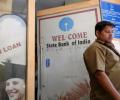
Bankers said the mammoth task of cleaning up the PSBs and improving their health will be a mammoth task for any chief executive.

While a DFI will help banks derisk their loan portfolios, creation of a bad bank will clean up their balance sheets.

Loans for Indian airlines have dried up as banks have become cautious to lend to the sector.

Here are five things that fraudsters are likely to say or do that should set the alarm bells ringing in your head.
 © 2026 Rediff.com - Advertise with us - Disclaimer - Privacy Policy - Sitemap - Feedback - About us - Terms of use - Grievances